

Advantages of Type-C Female Connectors
The standard cable of the Type-C female connector can carry a 3A current and supports "USB PD" beyond the existing USB power supply capacity, providing a maximum of 100W power.
The Type-C female connector has better electromagnetic interference (EMI) and radio frequency interference (RFI) mitigation features, ensuring data transmission is not interrupted or corrupted by interference.
It supports blind insertion (reversible plugging) and can withstand 10,000 repeated insertions and removals for a long service life.
With a new interface design, it measures approximately 8.4mm x 2.6mm. Power output capabilities: 3A for standard cables, 5A for the interface.
It supports both charging and data transmission modes.
It can transmit DisplayPort signals, supporting 4K UHD video transmission with a maximum data transfer speed of 10Gbps.
Usage Precautions for Type-C Female Connectors
Do not exceed the specified rated current during operation. Exceeding the rated current can accelerate the aging of internal components, potentially causing data transmission interruptions or anomalies, and may even damage the connector.
Do not arbitrarily replace Type-C female connectors with different specifications, as not all devices are compatible with all specifications. Using an unsuitable connector will lead to early damage.
Do not touch the interface with your hands during operation to avoid scratches from the pin chips. After the connector is powered on, never touch the interface to prevent electric shock hazards.
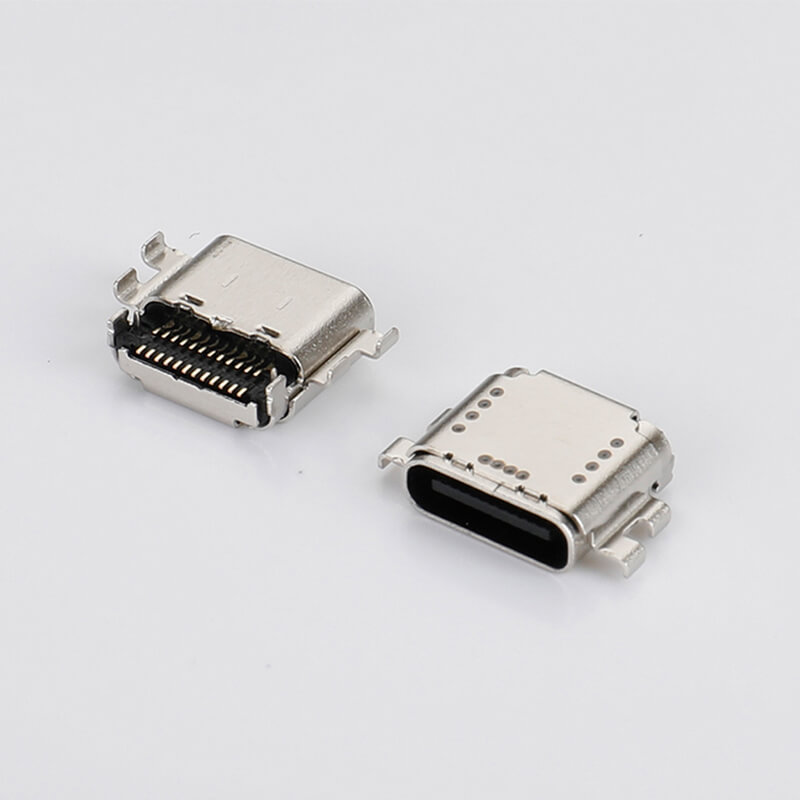
Fault Detection Methods for Type-C Female Connectors
The circuit of the Type-C female connector mainly includes filter capacitors, inductors, and a southbridge chip. Common faults include non-functional or abnormal USB interfaces, often caused by loose soldering of the connector, improper power supply, open inductors, or shorted capacitors.
Use a multimeter: Set it to the DC voltage range and zero it. Connect the black probe to the ground and the red probe to the voltage pin of the Type-C female connector. The normal voltage is about 5V.
Measure the resistance to the ground of the data and clock pins, which should be 500–700 ohms. The resistance values of the data and clock pins should not differ by more than 5 ohms.
If the data or clock pins are abnormal, measure the resistance to the ground of the capacitors, resistors, and inductors in the USB interface circuit (normal value: 500–700 ohms). If these are normal, the Southbridge chip may be damaged and need replacement.
If the interface circuit is abnormal, measure the fuse resistor (normal value: about 1 ohm). Follow the above steps to troubleshoot faults in the USB interface circuit.