

When purchasing a DC socket, choosing a durable, high-quality product is important. For switches and sockets, the quality of the internal copper strips directly determines their performance. Below are ways to evaluate the quality of copper strips in DC sockets:
Material
The material of the copper strip is critical. Pure copper was traditionally used, with red copper (high purity) offering the best performance, rose copper, and brass being the least durable. Due to the limited oxidation resistance of pure copper, copper alloys are now commonly used. These include copper-cadmium alloy, copper-nickel alloy, tin-copper alloy, and tin-phosphor bronze alloy—the latter being the most advanced.
Length
Longer copper strips are better (assuming the same material). The length determines the spacing between sockets. Wider spacing allows easier simultaneous use of two-prong and three-prong plugs. Older sockets often had short copper strips, leading to cramped spacing and incompatibility with multiple plugs.
Thickness
Thicker copper strips provide better elasticity, which extends the socket’s lifespan.
Manufacturing Method
Older riveted copper strips have visible joints and uneven materials at the ends. In contrast, single-piece molded copper strips have lower resistance, generate less heat, offer higher elasticity, and ensure better safety and conductivity.
Contact Type
Copper strips and plug contacts connect in two ways: point contact and surface contact. Surface contact is safer and more conductive, as point contact can cause sparks and loosen the copper strips over time.
Types of DC Sockets
DC sockets can be categorized in several ways:
By shape:
Straight plug-in: The plug aligns parallel to the socket, ideal for horizontal installations.
Right-angle plug-in: The plug connects vertically to the socket, suited for vertical installations.
By port count:
Single-port: One interface for basic power connections.
Multi-port: Multiple interfaces for connecting several devices.
By voltage:
High-voltage: For high-power environments.
Low-voltage: For standard power applications.
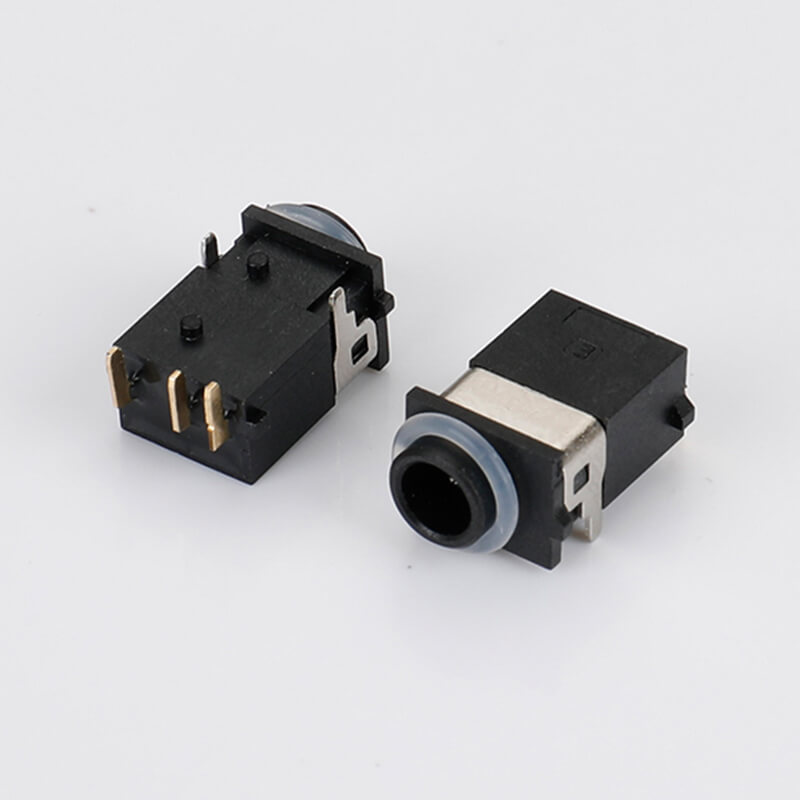
DC Power Socket Pin Definitions
A DC socket has three pins:
Pin 1: Common terminal (negative pole).
Pin 2 and Pin 3: Both are positive poles.
Pin 2: Connects to internal power.
Pin 3: Connects to external power.
Operation:
Normally, Pins 2 and 3 are connected (internal power is used).
When an external power plug is inserted, Pin 3 disconnects from Pin 2 and directly powers the device through Pins 1 and 3. Pin 2 is deactivated.