

Evaluation Standards for Waterproof DC Sockets
Nowadays, people's safety awareness is constantly increasing, and they have put forward requirements for the moisture-proof and fire-proof performance of various electrical appliances and electronic devices around their lives. As a socket specially designed to match the power supply of computer monitors, DC sockets are also quite common in our lives. So, how can we judge the waterproof performance of DC sockets? Let's take a look at the main evaluation standards for the waterproof performance of DC sockets together.
The waterproof performance of DC sockets also adopts the IP rating standard, which is an international standard used to determine the protection level. To see how the protection performance of a DC socket is, we mainly look at the last two digits XX of IPXX. The first digit X represents the dustproof level, ranging from 0 to 6, with the highest level being 6. The second digit represents the waterproof level, ranging from 0 to 8, and the highest waterproof level of a waterproof DC socket can reach level 8.
How does a DC socket achieve the waterproof effect? The waterproof sealing principle of a DC socket relies on as many as 5 sealing rings and sealing gaskets to achieve pre-tightening sealing under pressure. This kind of sealing will not lose the pre-tightening force during thermal expansion and contraction, and can ensure the waterproof effect for a long time. Water molecules cannot penetrate under normal pressure.
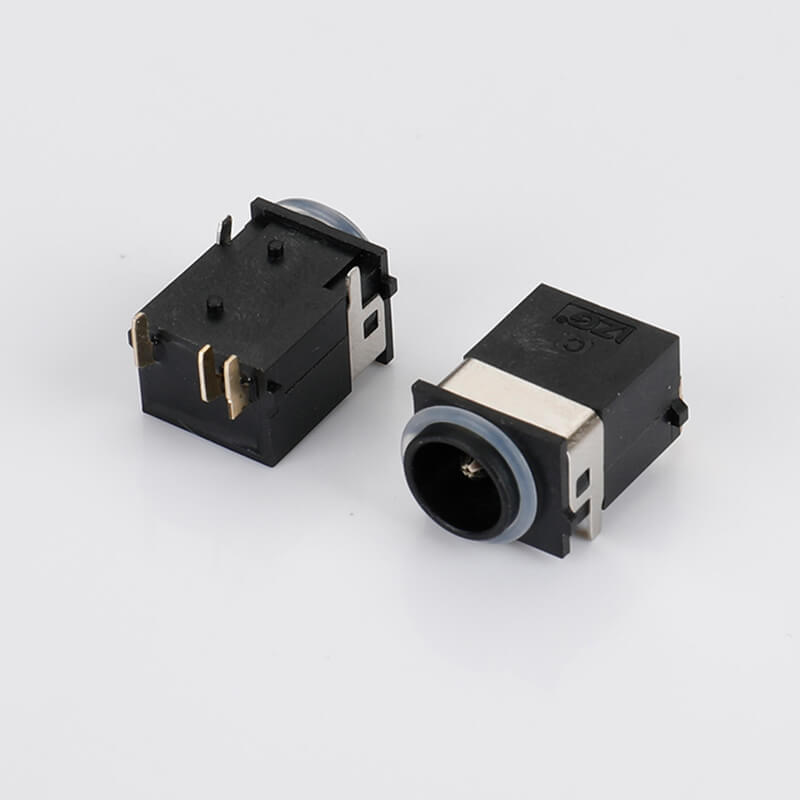
How to Determine the Quality of DC Sockets?
When we buy DC sockets, we generally hope to get a product with a long lifespan and good quality. For switch sockets, the quality of the copper sheets inside directly determines their quality. Today, let's talk about how to distinguish the quality of the copper sheets of switch sockets.
1. Material
The material of the copper sheet is the main factor determining the performance of the copper sheet. In the past, pure copper materials were mainly used. In terms of performance, red copper (also known as electrolytic copper) is the best, followed by red copper, and brass is the worst. Due to the limitations of the oxidation resistance of pure copper, copper alloys are now mostly used, such as copper-cadmium alloy, copper-nickel alloy, and tin-copper alloy. Currently, the tin-phosphorus-copper alloy has the best performance.
2. Length
Under the same material condition, the longer the copper sheet, the better. Because the length of the copper sheet determines the distance between the sockets. The wider the distance between the jacks, the more convenient it is to insert the two-prong and three-prong plugs simultaneously. In the past, many old-style sockets had short copper sheets, resulting in short distances between the jacks, so they could not insert the two-prong and three-prong plugs at the same time.
3. Thickness
The thicker the copper sheet, the better its elasticity, and correspondingly, the longer the lifespan of the socket.
4. Molding Method
For the old-style riveted copper sheets, it can be clearly seen that the materials at both ends are completely different from the material of the middle bridge, and there are obvious riveting points. The copper sheet formed in one piece has a smaller resistance than the riveted one, and the corresponding heat generation is also smaller, with better elasticity, a higher safety factor, and higher electrical conductivity.
5. Contact Method
There are mainly two contact methods between the copper sheet of the socket and the conductive sheet of the plug: point contact and surface contact. Surface contact has much higher electrical conductivity and safety than point contact because point contact is prone to generating sparks, and the copper sheet is more likely to loosen.